
Large-Scale and Climate Dynamics
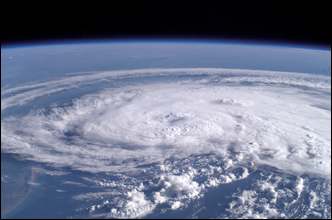
Hurricane Claudette from the International Space Station.
Courtesy of Gateway to Astronaut Photography of Earth.
The Large-Scale and Climate Dynamics program at Davis examines basic fluid dynamics and short-term climatic processes. Some of the research combines dynamics, thermodynamics, radiation and synoptic meteorology. The phenomena studied range in scale from a single midlatitude frontal cyclone up to global circulations. Some students are investigating fluid dynamic instabilities with linear and nonlinear models of frontal systems. Large-scale tropical circulations and their midlatitude interactions are incorporated into this program, as well. Most students are using various computer models to simulate atmospheric circulations. Some students are also studying observational data with advanced statistical techniques.
Select a faculty member's name below to visit their web page.
Joseph Biello
Profesor Biello's research focuses on the structure of the partial differential equations which govern the dynamics of fluids. Particularly fascinating is the wave phenomena in fluids - in particular in rotating fluid systems, of which Earth's atmosphere is our most important example. Nonlinearity in the rotating fluid equations create two important effects on the waves they describe. (1) Wave steepening and breaking is due to the interaction of the nonlinear and the linear properties of the wave. (2) Non-linearity causes interactions across a wide range of length scales, yielding upscale or downscale transports. The tropical atmosphere is a fascinating laboratory to study these waves and the effects of nonlinearity on natural phenomena. On set of phenomena that I have been studying is called tropical/midlatitude interactions. For example, nonlinear coupling causes tropical waves to generate midlatitude Rossby waves; weather patterns over Indonesia can suppress or enhance weather over the continental USA. Furthermore, nonlinear interactions can cause midlatitude Rossby waves to excite precipitating Kelvin waves over the deep tropics. A third phenomenon is the Madden-Julian Oscillation (MJO). The MJO is a classic example up a nonlinear, upscale atmospheric phenomenon wherein small scale structures (storm systems) organize to produce a large scale circulation (the MJO covers more than a quarter of the tropical Earth, and moves across three quarters of it).
Shu-Hua Chen
Professor Chen's research involves data assimilation and the study of idealized heavy orographic rainfall. A major forecasting problem is that there is not enough in-situ data over the oceans. One of the possibilities for improving model forecasting is to properly utilize remote sensing data to improve model initial conditions. In collaboration with Dr. Francois Vandenberghe at NCAR, Dr. Grant W. Petty at the University of Wisconsin, and Dr. James F. Bresch at NCAR, her group has applied SSM/I and QuikSCAT data to improve hurricane simulations. For heavy orographic rainfall, in collaboration with Dr. Y. L. Lin of North Carolina State University, she has studied the effects of the moist Froude number and the convective available potential energy on flow regimes associated with a conditionally unstable flow over a mesoscale mountain. In addition to these two directions, her research will also be extended to cumulus parameterization and the on-line tracer study in the near future.
Richard Grotjahn (Emeritus)
Professor Grotjahn has a number of research projects in large scale atmospheric climate dynamics. He works on the synoptic to global length scales. Examples of past projects include the following. (1) Fluid dynamical instability of midlatitude flows using such tools as: large linear eigenvalue problems, linear initial value problems, and nonlinear initial value problems in Cartesian and spherical geometry. Our approach is to ground our theoretical studies with targeted observational studies and vice-versa. (2) Forecasting work includes model verification and constructing historical analogs from past extraordinary weather events. (See the forecast analogs website for significant large-scale patterns associated with such regional events as: severe freezes, heat waves, and heavy rain.) These studies employ various statistical analysis tools. Current research includes the following projects: (3) studies of what factors, both local and remote, maintain the subtropical highs, (4) research following up on Dr. Grotjahn’s book on the general circulation, (5) studies of what model defects are causing specific Arctic region surface climate biases in climate models, (6) study of the origin of air reaching California (relevant to air quality compliance), and (7) application of analog techniques to identify the climatology of extraordinary weather in a climate undergoing global change.
Terrence Nathan
Professor Nathan's research is fundamental in nature and focuses on identifying and understanding the physical and dynamical mechanisms that govern the spatial and temporal evolution of large-scale atmospheric circulation systems. Professor Nathan's research involves combining observations with advanced mathematical techniques to study the following: tropical-midlatitude interactions during El Niño and La Niña flow regimes; stability of geophysical fluid flows; nonlinear dynamics of atmospheric circulations; and interactions among radiation, ozone and dynamics in the stratosphere. Additional research includes using proxy data (e.g. dendroclimatic reconstruction and historical records) to examine the impacts of meteorological events on exploration, including the Lewis and Clark expedition.
Paul Ullrich
Professor Ullrich's research in large-scale and climate dynamics focuses on understanding changes in synoptic scale weather systems in response to future climate change. The next century will see unprecedented changes to the climate system which will have significant repercussions on global human activity and international policy. The IPCC special report on extreme weather reports with confidence that the next century will see substantial warming, with a corresponding increase in regional temperature extremes and drought conditions, increases in the frequency of heavy precipitation events in wet areas, and increases in tropical cyclone wind speeds. These trends are of a broad global nature and do not necessarily reflect the influence of the changing global climate on regional scales, which are absolutely key for planning on the local, state and federal level. For this reason, an understanding of changing regional climate and synoptic-scale weather is an unmet challenge that must be addressed in the coming decade.
